

Q&A #3
Newsletter #51: scented questions and smelly answers

It’s another Q&A post! Today we’re talking about tips to build a scented vocabulary, Soviet perfumes, recent fragrance loves, and more.
Q: how did you decide on what blotters/mouillettes to buy? The ones that you keep in your purse. Topic, if it interests you: I’m newly on a path of perfume appreciation and struggle with coming up with descriptive language and with identifying/naming notes, more so for some perfumes than others. Which is not inherently a bad thing, I love that perfume is something I get to explore without needing words. But it’s also enjoyable to describe things. Do you have any thoughts on this? btw: Discovering your substack was the highlight of my perfume reading year. Thank you for sharing your gift with readers.
A: Oh this is so kind, thank you for reading!
First: blotters.
Two answers here: I’ve nicked enough blotters from stores to know what I like (thick creamy cardstock, foldable, flacon or perfumer strip over paddle or square blotter always). But I’m also an obsessive who has read enough basenotes forums and perfume books and fragrance insider articles to know what the general consensus is on good vs waste of time for most perfume tools of the trade, blotters included. I also make sure to swipe some from stores that stock the really good stuff and don’t care about restocking: if you’re Australian based the Mecca, Jo Malone and Guerlain blotters are all bag worthy.
That’s for my on the go perfume sniffing kit where I can’t tolerate dodgy blotters, because they irritate me. At home is a completely different story. I revert back to a primitive form. I will spray a perfume on a cotton ball, a post it note, a receipt (don’t recommend - laser printed ink always bleeds) or whatever scrap of absorbent material I have close to hand. Sometimes it even fun to note how perfumes can react to different surfaces. This all to say, don’t worry too much about investing in the good stuff.
Second: on scent, and scented language.
This is a very common struggle upon entering perfume world! Building an olfactive vocabulary can take time. But it’s absolutely something you can and should work on - both for your own joy and to help you understand perfumery better. There are classes and methods of building this, but as you’re asking me I will tell you that you have a good baseline: the world of scents and flavours that you already live in. What’s missing is deeper thought and cognition about these things, a connecting of synapses.
We can build that. Let’s give you an experiment to start off.
I want you to buy a lemon. (It can be any citrus, but lemons are especially good). You know the smell and flavour of a lemon. Even now as you read this you can probably recall its eye-scrunching acidity in the back of your mind, your palate.
Take your lemon home and cut off some of the peel, and then squeeze the peel between your fingers.When you do this, the essential oils trapped in the lemon peel are going to diffuse into the air. (Please, aim away from your eyes!!).
Forget that it’s a lemon. What does this smell like? How does it make you feel?
It’s harsh. Fresh, but with an edge that speaks to how quickly citrus fruit can rot and decay. (Cirtus always smells a little bit like spoiled fruit. Hunt out that smell in the air. Find it.) Scrubby, squeaky, like skin that’s been scrubbed too raw, your hair after shampoo and before conditioner.
It’s a smell that makes your spine straighten, demands attention: sharp bite, fresh zing, somehow a scent of yellow even though you know that’s a silly connection your mind has made to the visuals of the fruit. It’s a bright smell; a happy smell. Happy, with an edge.
Write all of this down. It doesn’t need to be neat, or pretty - just words on a page like a brain dump is absolutely fine.
Do this experiment over and over. Uncover new layers to this smell you thought you knew.
Research the aromachemical composition of lemon. The dominant scent profile of lemon are limonenes, which are turpenes, so now you know what turpenic can smell like. Think of perfumes you know that have a lemon or bergamot opening. Think of how different they are to the sharp, fresh, immediate smell of the lemon peel.
Now you’re starting to see how perfume is an imitation of life, how a perfumer must interpret the feeling and sensation of a smell.
Keep doing this with as many natural smells as you can find (they are the most complex). Some other great options:
rosemary,
carnations,
unwashed potatoes (seriously - they’re the key to understanding vetiver),
petrol (refined, yes, but still somewhat of nature),
honey,
mulch,
coffee or tea.
The way you unlock their scent will be different; the experiment will stay the same. Write down the feeling. Build the language.
These smells will help you connect between the emotion and the functional building blocks of scent. Paradoxically this is hardest to do with perfumes because they’re complex in a way that presses on the senses differently to natural smells. It’s like the way watermelon flavoured candy tastes completely different to actual watermelons.
I know it seems silly that the answer is go smell. But it’s really go smell and think, which is something we often have to train ourselves to do.
The good news? It’s really, really fun. You’ll start sniffing things everywhere you go. Clay pots. Old books. Shoe polish. Pencil shavings. That dying tree on the forest path. The hardware store. Every day is a new adventure when you are lead by your nose!
Q: What’s the best thing you’ve smelled in the past, say, 6 months?
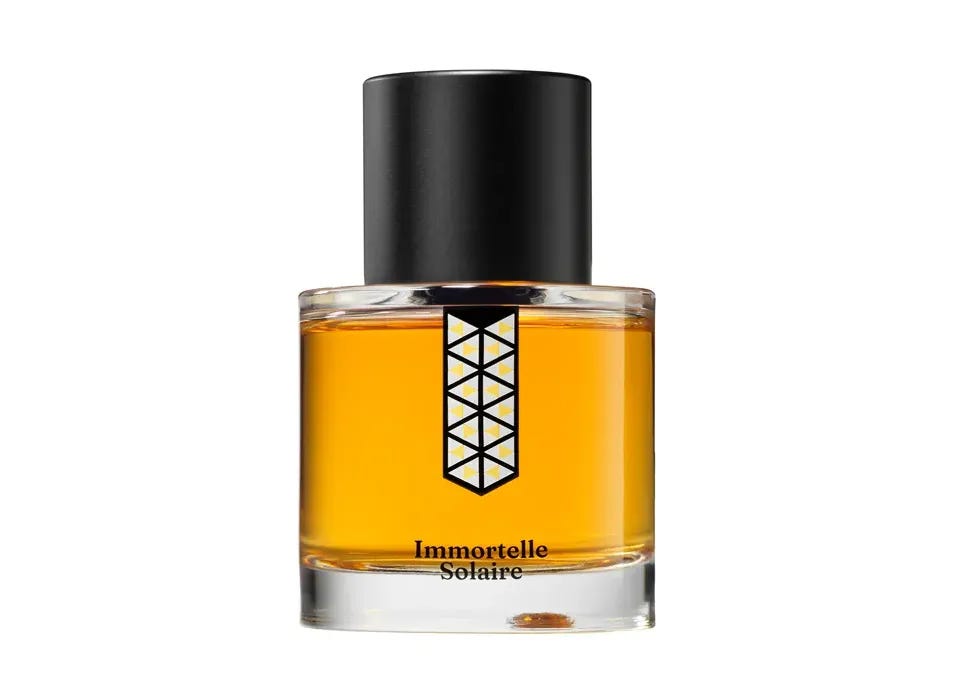
A: I went to Melbourne in October and smelled a lot of really brilliant things! I feel like immortelle is having a moment and I, personally, am always here for immortelle - I love its weird sweaty sticky maple-syrup residue on an empty plate vibe. So I smelled Immortelle Corse from Parfums d’Empire and Immortelle Solaire from Les Indomedables and they were both great. I mean they’re no Sables, but nothing can be….
I also got to smell a vintage formulation of Bandit, which made me both so happy and so grief stricken that I needed to walk for a little bit just to microdose the cycle of acceptance. And I’m always exploring the experimental end of perfumery, weird ouds and absolutes and the funky stuff. I’ve been deep diving into Byermia’s back catalogue - Tabac Sura took my breath away. When a perfume has a disclaimer that it might cause mild skin irritation, that’s my happy place.
I still haven’t smelled Eshal from Neela Vermeire. I am cross about this.
Q: I know you’re interested in Russia (I really enjoyed the piece on Ambre Russe!)—have you smelled any Soviet perfumes? I’m asking partially because of the Karl Schlögel book, which I did enjoy, but I found oddly lacking in actual scent description. I’m also curious about references to Soviet-produced perfume in fiction—in The Master and Margarita there are references to Mitsouko, Chanel no. 5, and Narcisse Noir and in We a character is named 4711, but maybe you’ve found other references. I would love any additional smell-related book recommendations, if you’ve read any new ones! Love your work!
A: Oh dear - see, the thing is if we start talking about this I’m never going to stop, and then this is going to turn into a Russia/Eastern Europe newsletter, and that’s not what anyone wants… but I did get very happy when I read this question, so thank you for asking!
You’re quite right, The Scent of Empires is dry - in style it appealed a lot more to the voluntarily reads books about WWI and the Napoleonic campaigns side of my brain than the perfume side! But it is very rare to read a book that genuinely takes perfume seriously as a cultural driver and shaper of history, so I am glad it exists. And Master and Margarita is one of my favourite books. The passage where they just start slugging out classic perfume names brings me so much joy!
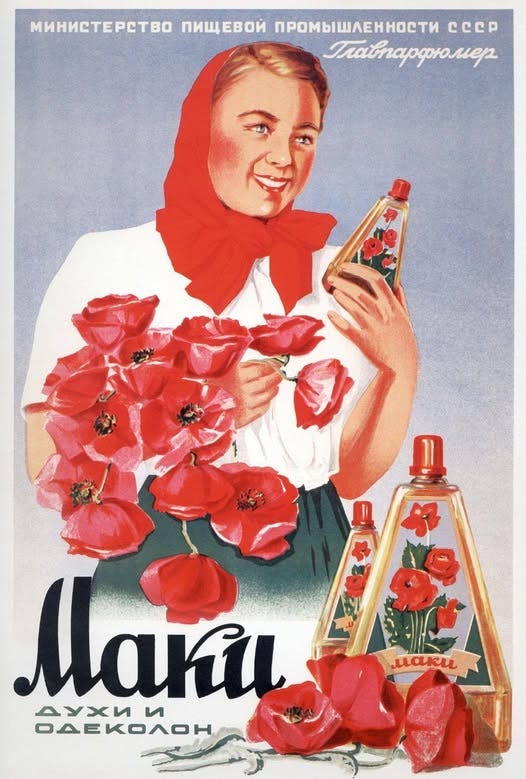
As you might expect I do often go on the hunt for iconic Soviet perfumes. I’ve smelled Krasnaya Moskva, Troynoy (oh boy… isn’t there so much to say about Troynoy!!!), Red Poppy (for which I have the classic Soviet poster framed in my house, above my perfumes!), and White Lilac. You can find decants or old bottles sometimes on ebay or etsy and especially if you look at European stores. They’re so much denser in structure than you would expect!
Olfactively I would say that most Soviet perfumes are simple but powerful - think like Yardley’s English Lavender. Culturally, like with so much of the Soviet experiment, there’s so much to unpack here.
Perfumes being created by the state and therefore trying to dictate and control even the olfactive environment; the simple yet evocative names calling back to nature, almost like the French Revolutionary calendar trying to kill god and romance and bring everything back to flowers and the harvest; the use of these perfumes, especially Krasnaya Moskva, as a touchstone to evoke memories of the Soviet world after its collapse. And it’s about scent as a byword for conformity too, like so much of the Soviet imperial experiment was, which has different meanings and context in the current climate.
We really will be here all day! But in terms of cultural references to Soviet perfumes, you really are spoiled for choice. Because these were perfumes sold by the state they became basically ubiquitous in Soviet everyday life and therefore rose to a higher cultural touchstone than perfume usually gets to be. Imagine if every woman you knew had the same bottle of perfume on her dresser. There’s a lot you could say about that. Anyway, there are plenty of poems and films and books that reference these perfumes, maybe more intensely than in any other culture. When everyone’s mother smells the same way, that hits a different psychological button in a civilization.
And lastly a perfume book I have my eye on is Demo Accords by the immensely talented Pia Long. Once I get my hands on a copy I will report back!
Q: I’m completely new to the fraghead world (I’ve always worn perfume but mostly the local-mall stuff, if that makes sense) and it feels like there are about a THOUSAND perfumes everyone says I MUST smell. It’s a little overwhelming. Where do you suggest a fragrance newbie starts?
A: I feel your pain - I think we have all been there! Diving deep into perfume sometimes feels like learning a language you thought you kind of knew, but it turns out you don’t know at all and even worse, you need to unlearn all the vocabulary you had! It can be tough. But stick with it because it will reward you.
Honestly? I would start exactly where you’ve been: the local mall. If you have access to perfumes you can spray and smell for free, always start there before sinking cost into samples or blind buys, etc. Any medium-decent designer store will have a lot of the classics (or at the very minimum, perfumes that resemble the classic structures) and they will give you a baseline.
What I want you to do is approach this with the energy of an eager anthropologist. You are not going to the store to buy a perfume, you are going to smell the perfumes and learn. Bring a pen. When you land in the perfume section, grab a good handful of the blotters (arrow shaped if possible; square if you must). Deal with the salesperson kindly but definitively. Then pick one end of the section and
SMELL. EVERYTHING.
I mean it. Smell it all. Write down every name of every perfume on your blotter. If you don’t know the names, describe the brand and bottle as best you can. (You are going to mix up the Narcisos. Don’t worry - everyone does). Smell them methodically. Do it in multiple trips if your nose gets tired. Spray the masculines and the feminines, the perfumes you know and the ones you’ve never heard of. Spray the ugly little Paco Rabanne robot bottles and the Mugler perfumes that look like the murder weapon from a Knives Out movie. No perfume is beneath you. Smell them all.
Then you need to go home and piece together what you’ve smelled with what they mean. You will learn that this perfume is a neo-fougere and that perfume is a classic amber or a gourmand. Smelling as much as you can is the only way to make that olfactive-cerebral connection between what people are talking about and what scents actually smell like. The goal is not to find perfumes that you like - the goal is to understand the breadth of perfumes that exist.
Once you’ve done this, then you’re ready to start exploring harder to find classics, niche and rarer perfumes online. Come back and we’ll talk through all of that another time!
Q: What’s a perfume you absolutely hate?
A: Oh, there are a lot. There are so many reasons you can loathe a perfume. There are perfumes I hate because of what they stand for, because they assume naivety or a lack of intelligence from the consumer, because they are crass or banal or a terrible use of a brilliant mind. For example, I have very little time for the brand Byredo, for many reasons. Seeing those little magnetic lid black and-white domed bottles with the sans-serif font makes my eye twitch!
But I think the spirit of the question is about a perfume I hate purely because of the way it smells, top to bottom. I’ll give you an answer that has never wavered since the first time I smelled it so many years ago: Chanel No. 5.
Q: What is your most popular article, and what is the one you’re proudest of? I’m a new subscriber and I have loved diving into your work!!!
A: Thank you so much, and welcome to Fumes! I am so happy to have you. I have to admit I don’t really spend much time (or any at all) looking at Substack statistics because it gives me anxiety! I’m always interested in growing Fumes and making my writing the absolute best it can be, but I sort of just trust that people who are interested in what I write will find their way here… I’m probably not ambitious enough, but it’s healthy for me!
That being said, I get a lot of great feedback on my super deep dive into Baccarat Rouge 540. And I have a lot of people tell me that my (even longer!) post about Le Labo got them into perfume as a hobby, which makes me very happy. They were both research intensive projects that took a lot of time to pull together, and I am quite proud of them.
Surprisingly my article about grief and lilies is very popular - that was a post where I deliberately challenged myself to stretch the boundaries of perfume writing and try and bring the feeling of a perfume in through writing itself rather than just description. I am proud of myself for publishing the Gris Clair article, because I hadn’t really ever intended to when I started writing it - it was more an exercise in making sense of emotion by pouring it onto the page like a bloodletting.
But I think maybe the article I’m proudest of - or should I say the article that I think best encompasses Fumes itself - is my article about Aesop. It’s the closest I have gotten (so far) to explaining the tension between art and capital that really defines modern perfumery, the vicious wheel that simultaneously traps us all and yet can also offer such unimaginable beauty. It was challenging to write because my ambition for the article was kind of greater than my skill at the time, so it took a lot of work! But weeks where I feel challenged and still happy with the article that results are always good weeks.
I want to say a huge thank you to everyone who submitted questions. I couldn’t fit them all into this post, but rest assured we will be back later in the year for more in depth answers! I’m going to keep the questions box open and you can submit anytime here:
In the meantime please do chuck anything at me in the comments below. I read every one and they bring me so much joy.
Until next time,
M x
I'm based in Kutaisi, near the Lesser Caucasus, and you've piqued my interest to pursue some local Soviet perfume research next time I'm in Tbilisi. Who knows what might be on offer in the old Soviet bric-a-brac at the flea markets there. I've been getting more into the Georgian Orthodox consecrated oils thanks to the brilliant Danica of The Eastern Dispatch, too. This part of the world definitely has its own scent culture and I hope you're here to experience it in person someday. As always, reading Fumes scratches my brain in all the best ways. Thank you for writing, Miccaeli.
This might interest you, Miccaeli.
https://knowablemagazine.org/content/article/society/2026/recreating-the-smells-of-the-past?utm_source=Knowable+Magazine&utm_campaign=163ffd7cc7-EMAIL_CAMPAIGN_2026_01_27_08_48&utm_medium=email&utm_term=0_150f6a5cbe-c402de6df9-546104601